
By Asaye Bankole
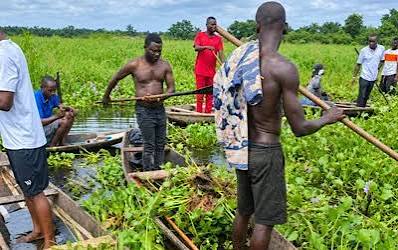
The Ondo State Oil Producing Areas Development Commission (OSOPADEC), in collaboration with the state government, has commenced a major operation to remove water hyacinth from waterways across riverine communities in Ilaje and Ese-Odo Local Government Areas.
The exercise, which started on Monday, November 2, 2026, is aimed at restoring navigation routes, improving transportation and supporting fishing and other economic activities in the affected communities.
The proliferation of water hyacinth has obstructed several waterways, making movement between communities difficult and disrupting the transportation of goods and fishing activities, which constitute major sources of livelihood for residents.
The Executive Director, Projects, OSOPADEC, Mallam Mallon Ogbaro, disclosed this during an inspection and monitoring exercise.
He represented the commission’s Executive Chairman, Prince Olabiyi Olaleye Poroye.
Ogbaro said the intervention followed complaints and appeals from residents whose waterways had been taken over by the aquatic weeds.
He attributed the exercise to the commitment of Governor Lucky Orimisan Aiyedatiwa’s administration and the OSOPADEC Board to addressing challenges confronting communities within the commission’s mandate areas.
According to him, fishing remains the principal occupation of many residents, while waterways serve as their major means of transportation, making the clearance operation necessary to restore their daily economic activities.
He assured residents that the exercise would continue, subject to available budgetary provisions, adding that the commission would also draw the state government’s attention to other communities requiring similar interventions.
The Director of Water, Waterways and Environmental Control, Engr. Goke Aworetan, said the operation was ongoing in several communities, including Imoluwa, Igbo-Egunren, Mahintedo, Alape, Ibila, Oropo, Sabomi, Ipoke, Biagbini, Oboro, Inikorogha, Fiyebrasintei, Ukparama and Arogbo.
Aworetan said the obstruction of waterways had affected residents’ ability to move between settlements, transport their goods and carry out fishing activities.
He explained that removing the weeds would also facilitate the transportation of timber to markets, ease the movement of agricultural produce and improve commercial activities across the riverine areas.
The director further identified the restoration of connectivity between Atijere and Igbokoda as one of the expected benefits of the intervention.
He said improved access to the waterways would strengthen trade, enhance productivity and create better conditions for economic activities across the affected communities.
The clearance exercise is expected to improve transportation and provide relief to residents of Ilaje and Ese-Odo, whose livelihoods depend largely on fishing, water transportation and related commercial activities.
COMMENTS