
By Asaye Bankole
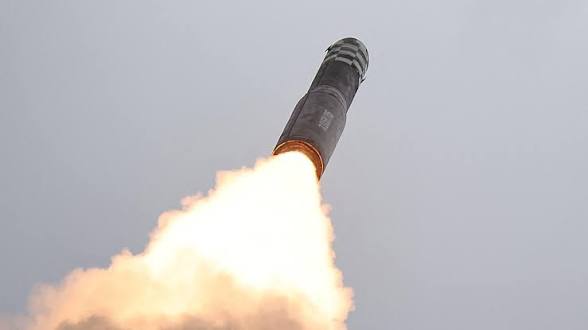
North Korea has fired multiple ballistic missiles towards waters off its eastern coast, prompting renewed concerns over escalating military tensions on the Korean Peninsula.
South Korea’s Joint Chiefs of Staff (JCS) confirmed the launches on Monday, October 12, 2026, stating that at least one missile fired from the Pyongyang area travelled more than 900 kilometres before landing in the sea.
Japan’s Deputy Defence Minister, Takashi Koyari, said at least two missiles were launched approximately 17 minutes apart and landed outside Japan’s exclusive economic zone.
According to Koyari, the first missile travelled about 220 kilometres, while the second covered more than 910 kilometres.
He noted that the longer-range missile followed an irregular flight path, raising the possibility that it could have been a hypersonic weapon.
South Korea’s presidential office condemned the launches, describing North Korea’s repeated missile tests as violations of United Nations Security Council resolutions and urging Pyongyang to halt such activities immediately.
Rising Military Tensions
The latest launches come amid growing military rivalry between North and South Korea, with both countries intensifying their weapons development and testing programmes.
South Korea’s military spokesperson, Jang Do-young, suggested that North Korea’s latest missile launches could be a show of force following Seoul’s recent test of a hypersonic missile.
On Thursday, South Korean President Lee Jae Myung oversaw the country’s first test-firing of a hypersonic missile, an unusual public demonstration of such a weapons test by a sitting president.
Lee’s office said the weapon, once fully developed, would strengthen South Korea’s ability to carry out surprise strikes against strategic targets on the Korean Peninsula.
North Korea had also tested a hypersonic intermediate-range missile on October 3.
The weapon was reportedly designed to evade missile defence systems deployed by South Korea and Japan.
Diplomatic Disagreements Deepen
Tensions between the two countries have also intensified following a landmine explosion in the Demilitarized Zone separating North and South Korea, which injured three South Korean soldiers.
Seoul demanded an apology after a joint South Korean-United Nations investigation concluded that North Korean forces had planted two landmines in the area approximately a year earlier.
Pyongyang rejected the accusation, describing it as a provocation.
Before the incident, South Korea had announced preliminary efforts to facilitate renewed dialogue between North Korea and the United States.
President Lee, who assumed office in 2025, has repeatedly expressed his willingness to reopen diplomatic channels with Pyongyang.
However, North Korean leader Kim Jong Un has continued to advance his country’s nuclear weapons programme while rejecting offers from Washington and Seoul to resume stalled negotiations.
Talks between Kim and US President Donald Trump collapsed in 2019.
Since then, Pyongyang has maintained that Washington must abandon what it describes as its hostile policy towards North Korea and drop its demand for denuclearisation as a condition for renewed negotiations.
The latest missile launches are expected to heighten regional security concerns as diplomatic efforts to ease tensions remain stalled.
COMMENTS