
- By Asaye Bankole
Nigerian engineering entrepreneur, Engr Femi Olafunmiloye, has called for stronger government support and better financing policies to enable local manufacturers compete effectively with imported products.
Olafunmiloye, the founder of Lafbart Innovations and Consulting Limited, said Nigeria’s manufacturing sector was capable of producing quality and cost-effective products locally but faced serious challenges from unfavourable government policies, limited patronage and high interest rates.
Speaking during an interview with D Chronicle Crew, Olafunmiloye said his company, established in Akure in 2010, was created out of his passion for engineering, automobiles and problem-solving.
He explained that his years of professional experience, including his work with global oilfield services company Baker Hughes, exposed him to engineering practices across different parts of the world, including the United Arab Emirates, several African countries, Europe, the United Kingdom, the United States and France.
According to him, the exposure strengthened his belief that Nigeria could develop practical solutions to many of its challenges if local expertise was properly supported.
“Lafbart is an engineering firm. What we try to do is to advance the Nigerian cause. We are solution providers that proffer solutions to everyday problems,” Olafunmiloye said.
He said the company had deliberately focused on developing affordable alternatives in areas including agriculture, healthcare, transportation, commerce, waste management and security.
‘Our goal is productivity and wealth creation’
Olafunmiloye said Labbart’s central objective was to improve productivity by providing tools and equipment that could help individuals, businesses and institutions perform their activities at lower costs.
“Our sole goal is to enhance productivity, which we believe leads to wealth creation and prosperity,” he said.
He explained that the company operates across manufacturing and assembly, automobile maintenance and after-sales services, consulting and technical training.
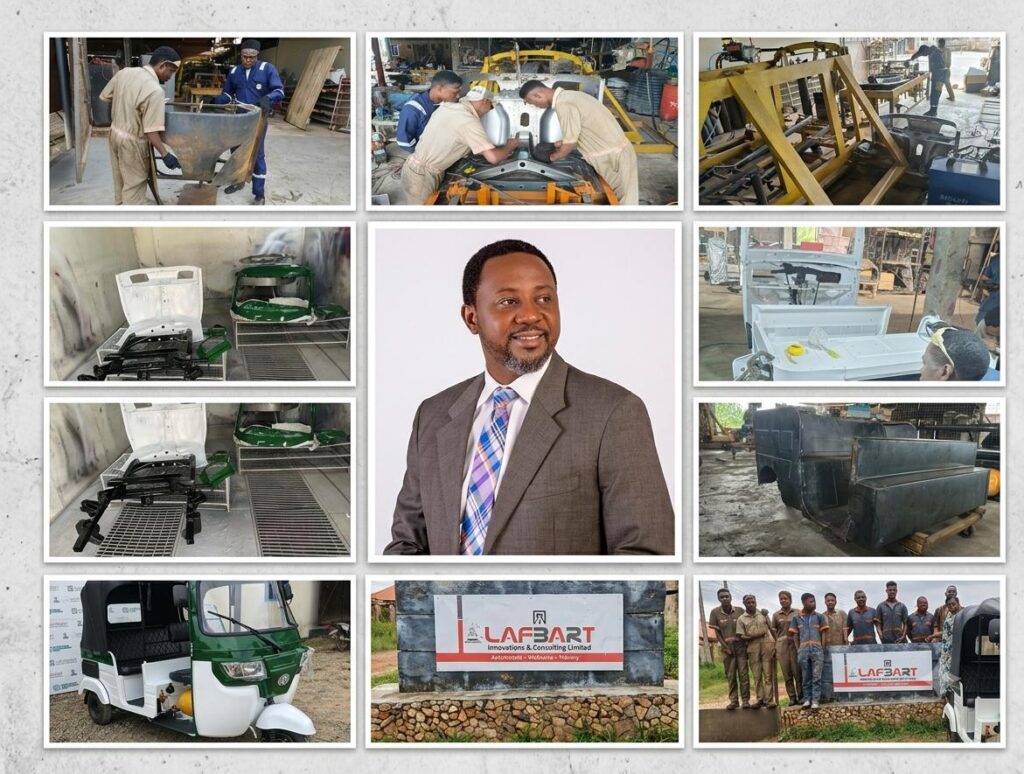
Lafbart manufactures and assembles three-wheelers, popularly known as tricycles, for agricultural applications, ambulances and other specialised purposes.
The company has also developed small four-wheel, all-terrain vehicles designed forward security applications.
Olafunmiloye, who described himself as a preventive maintenance expert, said Lafbart operates a comprehensive automobile workshop capable of handling different vehicle brands.
He added that the company uses technology to improve its automobile services and maintenance operations.
Lafbart pushes Local Content
Engr Olafunmiloye said one of Lafbart’s major achievements had been its efforts to increase local content in automobile manufacturing.
He claimed that the company had achieved up to 60 per cent local content in some of its products, describing the feat as evidence that Nigerian engineers could successfully develop and manufacture products locally when given the necessary support.
He recalled that Lafbart was identified as a potential partner in a government-backed initiative aimed at developing a “Made-in-Nigeria Keke.”
According to him, the company successfully developed the product, with significant components and processes carried out locally in Akure.
He said the die used in producing the body of the tricycle was made in Akure, while the company adapted available tools and equipment to achieve the required specifications.
Olafunmiloye said the project demonstrated what could be achieved when Nigerian engineers combined local ingenuity with international technical partnerships.
“We had to adapt a tool. We did not have the tool, so we had to look for a tool. We made it work,” he said.
He disclosed that Lafbart maintains partnerships with companies and technical interests in countries including India, China and the United Kingdom, which he said had helped the company leverage international experience while developing local capacity.
High interest rates threaten local manufacturing
Despite its achievements, Olafunmiloye identified access to affordable finance as one of the biggest obstacles facing manufacturers in Nigeria.
He said manufacturers operating in Nigeria were being forced to compete with companies from countries where businesses could access funds at significantly lower interest rates.
“Interest rate is 30 per cent. We are competing with the Indians and the Chinese that get their interest rate at two per cent, three per cent,” he said.
He argued that local manufacturers could not compete fairly in such an environment, particularly when imported products were readily available in the Nigerian market.
According to him, government policies should be designed to reward companies that invest in manufacturing, create employment and develop local technical capacity.
“Government policy stands out number one. By way of government policy and government patronage, there is a lot more that can be done,” he said.
Olafunmiloye maintained that it should not be more profitable for businesses importing finished products purely for trading purposes than for companies investing billions of naira in local production.
He called for stronger incentives, government patronage and financing mechanisms for manufacturers willing to invest in Nigeria.
‘Ondo can become South-West automotive hub’
The entrepreneur also expressed confidence that Ondo State could become a major automotive manufacturing centre in the South-West if the right policies and infrastructure were put in place.
“Ondo State by now should be known as, next to Lagos, the automotive hub of the South-West,” he said.
He argued that the state possessed the human resources and entrepreneurial capacity required to support a thriving automotive ecosystem.
According to him, stronger collaboration between government, manufacturers, tertiary institutions and technical training centres could create jobs while reducing dependence on imported vehicles and components.
Training the next generation of technicians
Beyond manufacturing, Olafunmiloye said Lafbart had invested significantly in technical and vocational education.
He disclosed that the company is an accredited Federal Government training facility and has participated in automobile training programmes under different government initiatives, including N-Power and the current Technical and Vocational Education and Training (TVET) programme.
He said the company combines theoretical instruction with hands-on practical training to equip participants with employable technical skills.
“We are specialists in imparting knowledge and skills to people, and we do this both in theory and in real-life practical situations,” he said.
Olafunmiloye said Nigeria’s economic development would depend largely on its ability to equip young people with practical skills and create an environment where those skills could be converted into productive businesses and employment.
‘We are barely scratching the surface’
Looking ahead, Olafunmiloye said Lafbart was still at the beginning of its long-term ambition.
He said the company’s focus would remain on developing practical, affordable and locally relevant solutions rather than simply engaging in importation and trading.
“We are barely scratching phase one of our dream for Lafbart,” he said.
He added that the company intended to deepen its work in agriculture, commerce, waste management, security and automobile manufacturing.
For Engr Femi Olafunmiloye, the future of Nigerian manufacturing depends on moving beyond consumption and importation towards production, innovation and the development of local technical capacity.
He said the country could create greater prosperity if more businesses were encouraged to manufacture locally, employ Nigerians, develop skills and solve problems through home-grown technology.
“It is possible to do anything. Nothing is impossible,” he said, describing problem-solving as the philosophy driving his business.
COMMENTS