
By Asaye Bankole
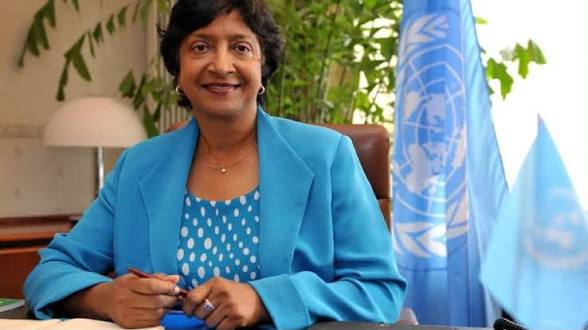
South African jurist Navanethem “Navi” Pillay has won the 2026 Nobel Peace Prize for her contributions to international law, human rights and efforts to ensure that war crimes, crimes against humanity and genocide are prosecuted.
The Norwegian Nobel Committee announced the award on Friday, October 9, 2026, praising Pillay for her courage, integrity and commitment to strengthening international justice.
Born in Durban, South Africa, to a family of Indian Tamil origin during the apartheid era, Pillay built a distinguished legal career challenging discrimination and promoting equality and human dignity.
Her career includes defending Nelson Mandela and other anti-apartheid activists, serving as a judge of South Africa’s High Court and the International Criminal Tribunal for Rwanda, and working as the United Nations High Commissioner for Human Rights.
She has also served as a judge at the International Criminal Court.
Pillay chaired the United Nations Independent International Commission of Inquiry on the Occupied Palestinian Territory until recently. She currently serves as a judge at the International Court of Justice in proceedings concerning allegations of genocide against Myanmar.
Landmark Contributions to International Justice
The Nobel Committee highlighted Pillay’s role in advancing international legal principles, particularly in cases involving sexual violence and genocide.
During her service at the International Criminal Tribunal for Rwanda, she contributed to legal developments recognising rape and sexual violence as acts that could constitute crimes against humanity and genocide.
The committee also praised her efforts to hold governments and individuals accountable under international law, describing her as one of the most respected international jurists of her time.
Nobel Committee Warns of Threats to International Law
In announcing the award, the committee expressed concern over growing pressure on international legal institutions, warning that political interests and the actions of powerful nations increasingly threaten the global justice system.
It stressed that international law remains essential to resolving disputes peacefully and preventing conflicts, particularly at a time of increasing global instability.
The committee also noted that powerful countries have sometimes avoided accountability, undermining trust and equality in the international legal system.
‘Peace Requires Justice’
The committee said Pillay’s recognition underscores the importance of the rule of law in maintaining peace and resolving conflicts without violence.
It praised her commitment to justice, accountability and human dignity, noting that her career demonstrates the importance of strengthening international institutions.
The committee concluded that Pillay’s work offers hope and inspiration to those striving for a more peaceful world, reaffirming the principle that lasting peace can only be achieved when justice is upheld.
COMMENTS