
By Asaye Bankole
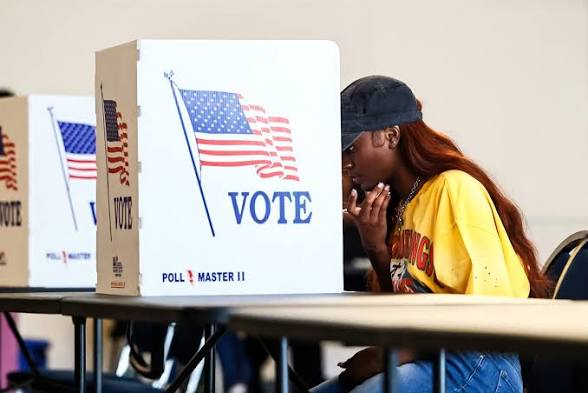
The Democratic Party has regained control of the United States House of Representatives following a strong performance in the 2026 midterm elections, ending the Republican Party’s four-year dominance of the lower chamber of Congress.
The election outcome was confirmed late Tuesday night, November 3, local time, after Democrats secured enough seats to take control of the 435-member House.
The victory marks a significant political setback for President Donald Trump and his Republican Party, which had maintained control of both chambers of Congress since the 2024 presidential election.
Democrats needed to gain at least five seats to secure a majority in the House.
All 435 seats were contested in Tuesday’s election, with members elected for two-year terms.
Before the election, the outgoing 119th Congress comprised 218 Republicans, 214 Democrats, one independent member and two vacant seats.
Following the Democratic victory, House Minority Leader Hakeem Jeffries, who represents New York, is expected to emerge as the next Speaker of the House, replacing Republican Mike Johnson of Louisiana, who has occupied the position since 2023.
If confirmed, Jeffries would make history as the first Black American to become Speaker of the House.
The position also places him third in the line of succession to the US presidency, after the president and vice president.
Democrats made significant gains by defeating several Republican incumbents in closely contested congressional districts across the country.
In Iowa, Democratic candidate Sarah Trone Garriott defeated Republican incumbent Zach Nunn in the state’s 3rd Congressional District.
In Virginia, Elaine Luria secured victory over Republican Jen Kiggans in a closely fought contest.
Democrat Janelle Stelson also defeated seven-term Republican Congressman Scott Perry in Pennsylvania’s 10th Congressional District.
Meanwhile, Democratic lawmakers Ilhan Omar and Ro Khanna successfully retained their seats in Minnesota and California respectively.
The Democratic gains were widely attributed to growing public dissatisfaction with the Trump administration, whose approval ratings had reportedly fallen to record lows in the weeks preceding the elections.
Reacting to the outcome, former US President Barack Obama said the election results reflected voters’ desire for leadership capable of bringing Americans together and addressing the country’s pressing challenges.
In a message posted on X, Obama declared that Americans had sent a clear message through their votes.
He also commended Democratic candidates who secured victories in traditionally Republican strongholds and encouraged supporters to remain politically active during the remaining two years of Trump’s presidency.
Similarly, independent Senator Bernie Sanders welcomed the Democratic victory, saying control of Congress would provide the party with an opportunity to hold President Trump accountable.
Sanders called on Democratic lawmakers to prioritise the welfare of ordinary Americans, particularly working families, while addressing economic inequality and the growing concentration of wealth.
He insisted that the party must take stronger measures to tackle income disparities and improve economic conditions for struggling households.
President Trump also acknowledged the Democrats’ performance, offering unusual praise for their campaign during an interview with Fox News.
According to him, the opposition party had campaigned effectively and demonstrated determination throughout the election process.
The Democratic takeover of the House represents a major shift in the political balance of power in Washington, where Republicans had previously controlled the presidency, the Senate and the House of Representatives.
With the new 120th Congress scheduled to begin on January 3, 2027, the development is expected to reshape legislative activities and intensify political scrutiny of the Trump administration.
The Democrats’ victory could also complicate the president’s efforts to advance his legislative priorities during the final two years of his current term.
COMMENTS